


Use AI where it can genuinely remove work, not simply add another tool.
AI strategy, agents, automation and adoption: we look for places where technology can simplify an operation, accelerate a decision or help a team work more effectively.
The best use case is not necessarily the most impressive one.
AI becomes interesting when it fits into a task, process or decision that already exists inside the business.
We start with the actual work: what takes time, what repeats, what depends on large amounts of information or what could be better assisted.
Then we decide what simply needs a better interface, what can be automated and what should remain under human approval.
Find the use cases that genuinely deserve to be built.
Before choosing a model or tool, we look for problems where AI can create enough value to justify integration.
We examine repetitive tasks, information volume, frequent decisions, customer interactions and internal operations.
Each opportunity is then assessed by value, feasibility, available data and the level of control it requires.
Request or event
Data and knowledge
Reasoning and orchestration
CRM, APIs, search, documents
Prepare or execute
Human when required
An agent becomes useful when it understands context and can use the right tools.
An agent should not simply answer a question. It can retrieve information, use tools, prepare an action and request approval where necessary.
We define what the agent can see, what it can use, which actions it can perform and when a human needs to take over.
This allows us to build customer-facing, internal and operational assistants around the actual way the business works.
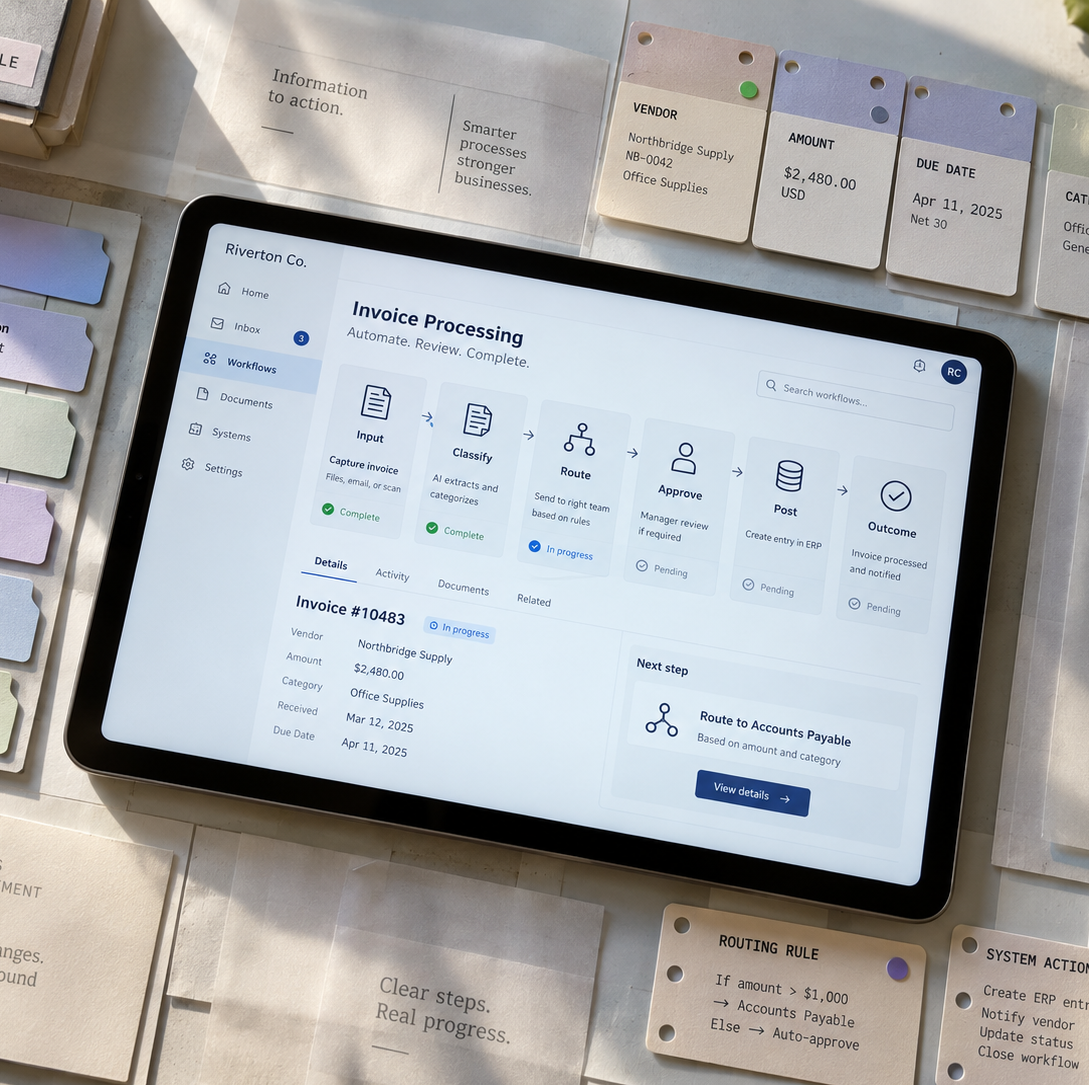
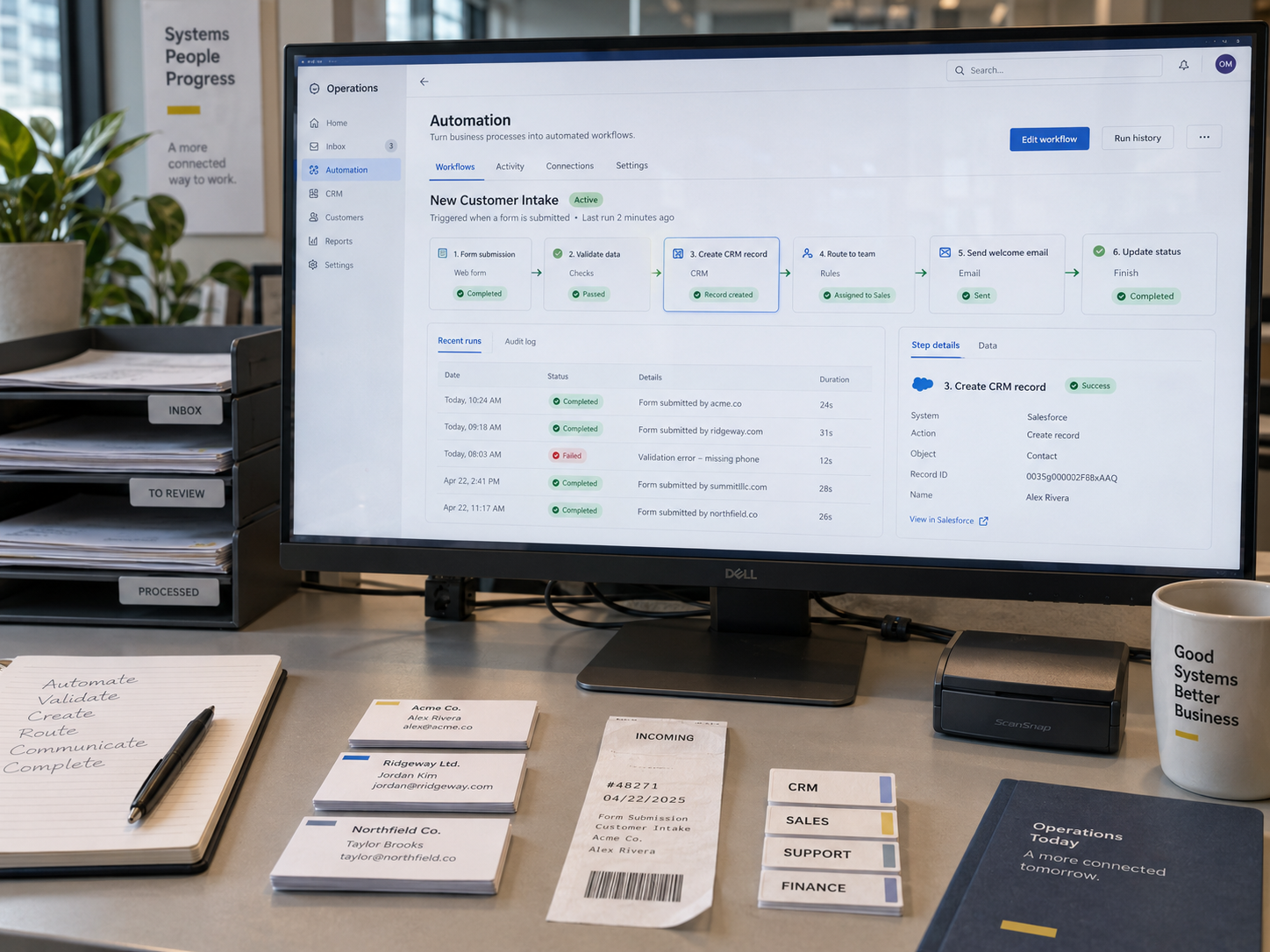
Move information without asking someone to copy it five times.
A large part of automation is simply making tools and process steps communicate correctly.
We connect forms, CRM, email, APIs, databases and internal tools so repetitive actions can happen automatically.
AI is used where a step requires understanding, classification, summarisation or generation — but it is not added when a normal rule is enough.
New form
Information classified, delivered and ready for the next action.
Same principle: make information easier to understand and use.
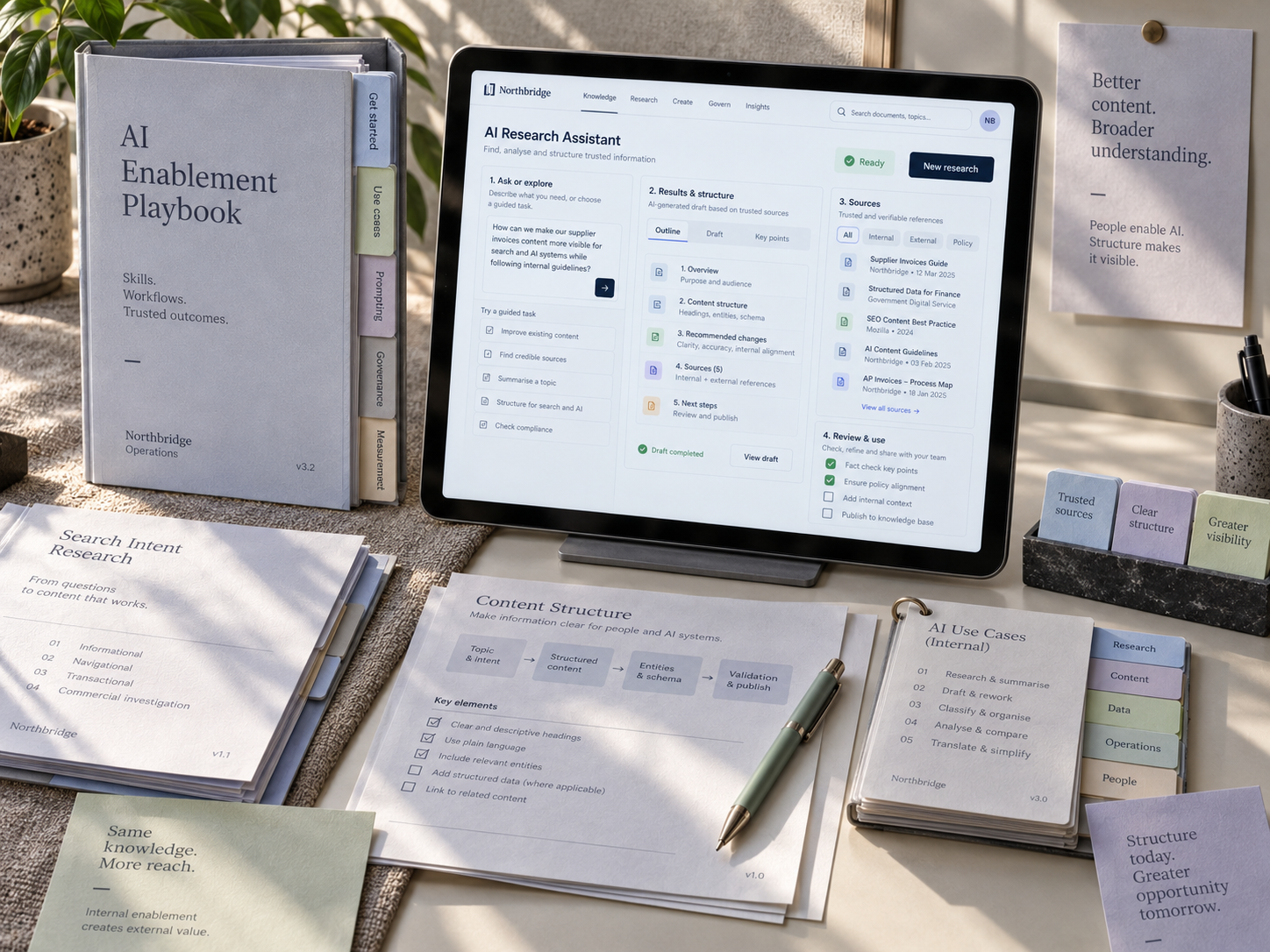
Help your team use AI properly — and help your brand stay visible in a new search environment.
Internal adoption and external visibility ask two different questions: how does your team use AI, and how do generative systems understand your business?
We help teams develop practical uses, simple rules and working methods suited to their jobs.
At the same time, we can work on visibility inside generative search and AI interfaces through clear, structured and credible content.
Before automating, five things need to align well enough.
A good model does not compensate for an unclear use case, unusable data or a process nobody genuinely understands.
Ready for AI?
Technology is only one part of the system.
Use case
A precise problem with sufficiently clear value.
Data
The necessary information exists and can be used.
Systems
AI can connect to the tools it requires.
Controls
Permissions, approvals and limits are defined.
People
The team knows how the new capability fits into real work.
The best AI project is not the one that automates the most. It is the one where responsibility stays clear while the work becomes simpler.
More automation should not make the system less understandable.
AI projects remain useful when we know what they can see, what they can do and where people remain in control.
Utility
Start with a real problem rather than technology looking for somewhere to go.
Human control
Keep approval where the action or consequence requires it.
Permissions
Clearly limit what the system can access and do.
Observability
Be able to understand what happened when a workflow acts.
Integration
Build around the systems already used by the business.
Adaptability
Change rules, tools and behaviour as requirements evolve.
Pricing depends on the process, connections and responsibility given to the system.
We can begin by identifying useful opportunities, building a first automation or developing an integrated system.
Discovery
Decide what genuinely deserves automation or AI assistance.
- Process analysis
- Use cases
- Prioritisation
- Risks
- Roadmap
Implementation
Build an agent, automation or assistant connected to actual work.
- Workflow
- AI or agent
- Tool connections
- Interface
- Testing
- Deployment
Integrated
Connect multiple tools, data sources and processes into a broader system.
- Multiple integrations
- Permissions
- Human approval
- Monitoring
- Scalable architecture
Custom
For internal products, specialised agents or complex business integrations.
- Custom architecture
- Specific integrations
- Business workflows
- Adapted support
API, AI model, licence and third-party service costs are separate unless explicitly included.
Let’s start with the work you want to make simpler.
You do not need to know which model, agent or technology to use before telling us about the problem.